Chlorine Program
Note: We suggest a 3-day per week program.
Sunday:
- Test the Alkalinity and adjust if needed.
- Test the pH and adjust if needed.
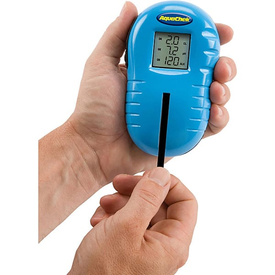
- Test the Chlorine and add tablets (1 tablet per 7,500 gallons) to the skimmer on the side of the pool.
- Shock the pool with non-chlorine Shock (such as Blast) even if the pool looks perfect.
Tuesday:
- Test the Alkalinity and adjust if needed.
- Test the pH and adjust if needed.
- Test the Chlorine and add tablets (usually 1 tablet per 7,500 gallons) to the skimmer on the side of the pool.
Friday:
- Test the Alkalinity and adjust if needed.
- Test the pH and adjust if needed.
- Test the Chlorine and add tablets (usually 1 tablet per 7,500 gallons) to the skimmer on the side of the pool.
Helpful Hints:
- Shock (Blast) = 1 lb. per 10,000 gallons of water.
- pH Plus = 1 lb. raises 10,000 gallons 0.2 on test strips.
- pH Minus = 1 lb. lowers 10,000 gallons 0.2 on test strips.
- Alkalinity Plus = 1 lb. raises 10,000 gallons 10 ppm.
- Any tablet or granular chemical goes into the skimmer with the filter running.
- Conditioner must be dissolved before putting into the skimmer or place Conditioner in a nylon stocking and place into the skimmer.
- 3” Jumbo Tablets can be used three times per week.
- Use algaecide per the manufacturer’s instructions as additional protection.
- Use Phos-Free & Pool Perfect weekly in place of algaecide.
- Water level should be approximately 1” from the top of the skimmer opening or the pump may lose its prime.
Perma Salt Program
Note: At the beginning of each season, install a new Perma Salt Replacement Chamber and follow the steps below.
- Balance the water.
a. pH: 7.2-7.8.
b. Total Alkalinity: 80-120 ppm.
c. Calcium Hardness: 230-350 ppm.
d. Total Dissolved Solids: 1500 ppm. - Turn on the Perma Salt System and set the control dial to 4, which is the highest setting for at least 48-72 hours.
- Add 25 lb. Preparate. Note: DO NOT swim for at least 24 hours after adding Preparate.
- Keep the dial turned up until the copper level reaches .03-.06 ppm.
Bi-Weekly Schedule (every 2 weeks):
- Test the water for pH, Alkalinity and Copper. The amount of copper indicates the level of natural minerals in the water.
- Adjust the Perma Salt System as needed using the control dial.
- Add 1 bag of Initiate. Note: Various conditions may require an additional bag of Initiate such
as high bather load and consistent temperatures around 100 degrees. - Add 1 bottle of Klairate.
- Add 1 bag of Re-Activate.
- Test the copper level and adjust the control dial, if necessary, to maintain residual level within .03-.06 ppm.
Vacuuming the Pool
- Attach the vacuum pole to the vacuum head. Then force the swivel cuff of the vacuum hose onto the water fitting on the vacuum head.
- Attach the other end of the hose to the skim vacuum adapter. Put the hose and the vacuum pole (with the head attached) into the water. Hold onto the end with the skim vacuum adapter attached.
- Hold the skimmer vacuum adapter over the return jet while the system is running in filter mode. This will fill the hose with water. When the hose is full the vacuum head will rise, bubble, then sink back down. Be patient. If there is any air in the hose, the pump will lose prime. It will then be necessary to start over.
- While keeping the vacuum adapter under the water, turn at a 45* angle , and slide it into the skimmer. It will suck down onto the skimmer basket. The water will now be pulled from the bottom of the pool.
- If the pump loses prime, there was air in the system. Re-prime the pump, and start over.
- While vacuuming, move the pole very slowly. If it moves too fast, the dirt will simply be stirred up. The pool will look clean when finished, but the dirt will settle back out the next day, so move slowly.
- Automatic pool vacuums hook-up the exact same way. It is still necessary to prime the hose first. The water flowing through the sweep is what powers it.
- Many pool sweeps will have flow regulators to set the right amount of the water flow through the sweep. Refer to your owner’s manual for details.
- If the pool sweep is the type that can climb the walls, and your pool has two returns, the bottom return should be turned off while the sweep is in operation. If this is not done the sweep can get stuck to the bottom.
- A trick to cut down on how often you have to have to vacuum your pool is to make sure the returns are aimed down and away from skimmer. This will get the pool water to sweep the dirt into the center of the pool for easy vacuuming. This is why some pools have returns.